AI Document Automation for UK Insurance Claims in 2026
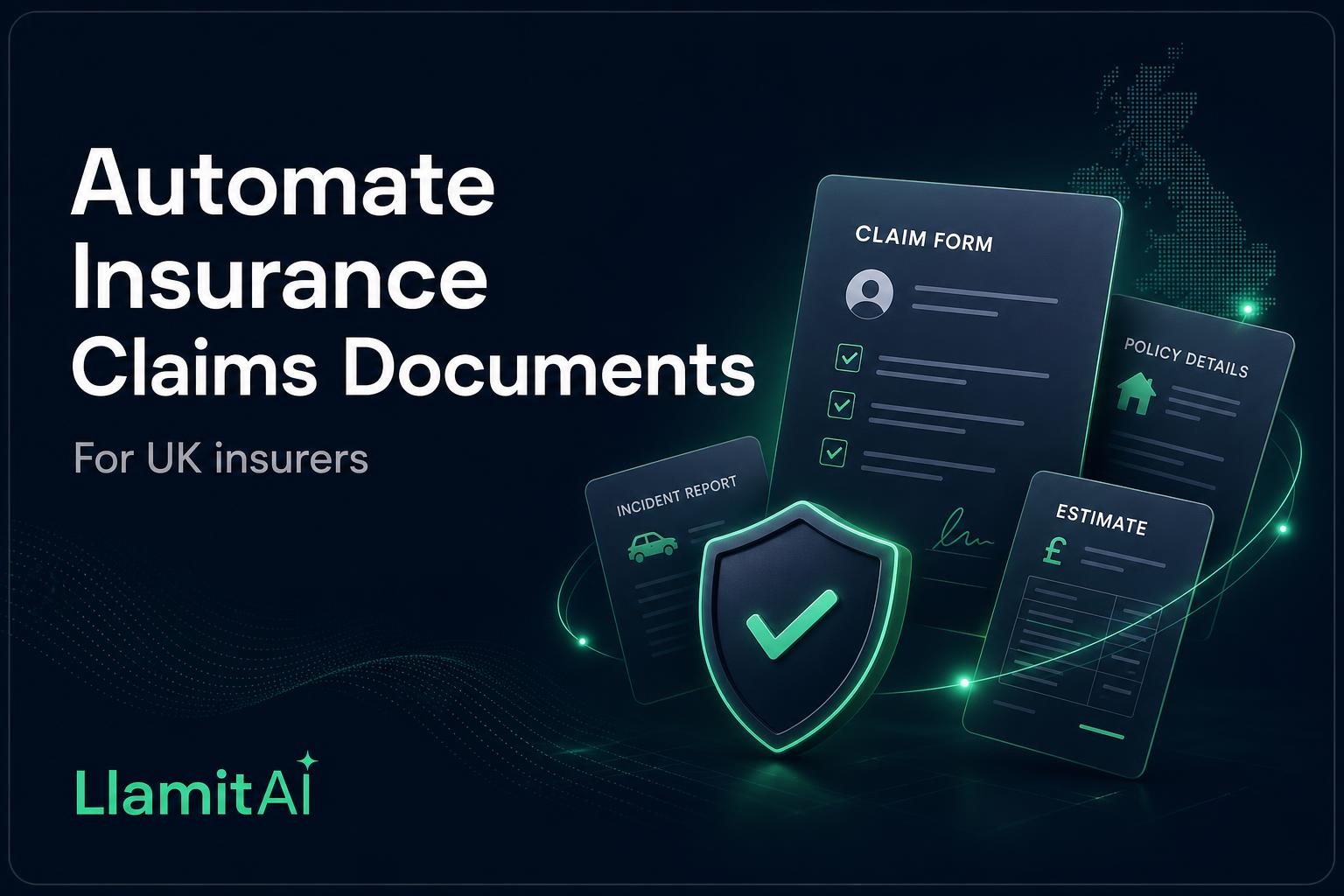
UK insurance operations still spend most of their working day moving paper. Credit protection, motor third-party, and specialty lines each have their own document quirks — but the underlying job is the same: classify, validate, chase what's missing, and pass clean structured data to the next system. This is exactly where AI document automation now produces measurable savings, without auto-deciding any claim.
Why claims operations are still document-heavy
Even modern insurers run a long tail of unstructured intake: scanned claim forms, photos of damage, medical certificates, police reports, broker emails, third-party invoices. Most workflows still rely on a human reading every file and rekeying values into a TPA or insurer portal.
The cost shows up as cycle time, leakage, and complaints. The FCA's expectation around prompt and fair claims handling means insurers need cleaner, traceable submissions — not faster decisions made by a black-box model.
What 'automation' actually means here
Automation in 2026 is no longer about brittle templates or regex over OCR. Modern systems combine vision-language models with rules engines: the AI classifies, extracts, and validates, while the rules engine enforces policy logic. A human stays in the loop on every exception.
For a credit protection claim, the system identifies the trigger (death, disability, sickness, unemployment), validates dates and signatures against the policy, and flags exclusions. For a motor claim, it splits the pack into forms, photos, medical evidence, and invoices, runs completeness checks, and only escalates exceptions.
Five capabilities to evaluate when buying
1. Multi-format intake — email, PDF, photo, broker portal — without a separate pipeline per channel.
2. Policy-aware validation — the system needs to understand exclusions and conditions, not just extract fields.
3. Audit trail — every extracted field linked back to the source document and the model version that produced it.
4. Human-in-the-loop UI — exception queues that match how your claims handlers already work.
5. Integration depth — REST APIs, SFTP, and pre-built connectors to common TPA/insurer portals.
Typical ROI signals
Insurers running document automation on credit protection lines report 6x faster document processing, 95%+ accuracy on compliance checks, and meaningful cost reduction within the first quarter of go-live. The savings come from collapsing chase-cycles and removing rekeying, not from auto-deciding claims.
Frequently asked questions
Does AI document automation replace claims handlers?
No. The systems that perform well in production handle intake, validation, and completeness checks. Every decision still goes to a human handler, who now starts from a structured, validated file instead of a stack of PDFs.
Is this FCA-compliant?
Aligning with FCA prompt-and-fair-claims expectations requires traceability and human oversight. Look for vendors that link every extracted field back to its source document and version every model output. LlamitAI does both by default.
How long does a typical implementation take?
For credit protection or motor claims, expect 6–10 weeks from kickoff to first production workflow when the insurer can provide a sample of real document packs and the target output schema upfront.
Keep reading
Automatización Documental para Microcréditos en LATAM (Guía 2026)
Cada expediente de microcrédito mezcla cédula, comprobante de domicilio, boletas y fotos. La IA documental ya redujo 50–70% los tiempos en instituciones LATAM. Te contamos cómo.
Fund Freezing Compliance in Latin America: A 2026 Playbook
Fund freezing orders arrive by email, fax, and circular — with 24–72 hour deadlines and zero room for error. Here's how leading LATAM banks are automating intake without sacrificing compliance.